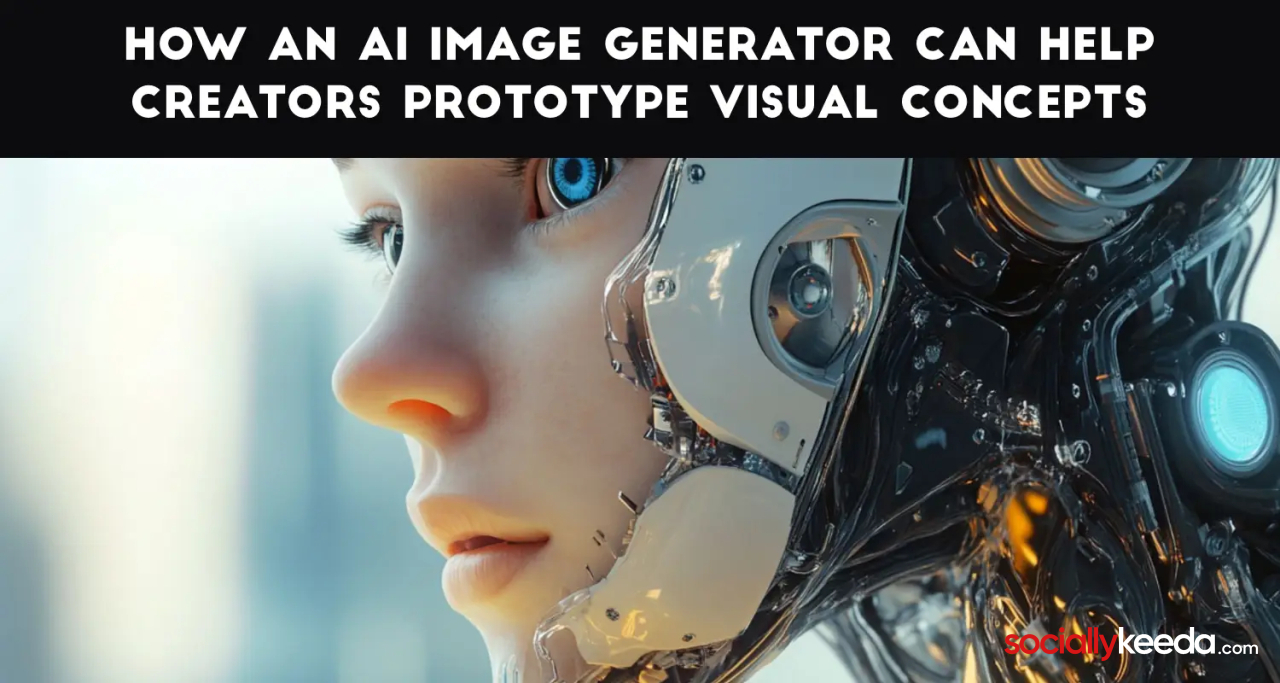
Production is expensive when the concept is uncertain. Every hour of studio time, every day of crew availability, every rental vehicle and rented location are costs that compound when the creative direction is still being worked out during the shoot rather than before it. Directors and visual producers who have managed pre-production know that the conversations that happen around a table in a development room — “I’m thinking more blue, more industrial, more rain-soaked streets” — need to be resolved before the production machine starts moving, not during it.
The challenge is that those conversations are hard to have at a productive level without something to react to. Describing a visual direction verbally is imprecise. Pulling reference images from the internet works but takes time and rarely produces the exact intersection of qualities you are looking for. What the pre-production room needs is something close to a visual hypothesis — a concrete enough rendering of the direction to make the conversation specific.
Why Concept Uncertainty Makes Production More Expensive
The cost of an unresolved creative direction is not just the wasted production time — it is the cascading revision cost. If a shooting day reveals that the agreed-upon direction is not working, the corrective path requires either a second shooting day (expensive), a significant departure from the plan that accommodates what can be salvaged on location (creatively limiting), or a post-production rescue effort that costs time and money without fully fixing the problem.
The better answer is to resolve uncertainty before the production clock starts. That means having the kind of clear visual references that allow everyone involved — director, producer, DP, art director, client — to be reacting to the same thing in pre-production rather than discovering they had different images in mind on the shooting day.

– Advertisement – Continue Reading Below –

Pollo AI’s AI image generator serves this function at a cost and speed that makes it practical to generate multiple visual directions — not just one — before settling on the production approach. Instead of one reference image for each direction, you can generate a small set: a few lighting variations, a few environment interpretations, a few character-and-scene combinations. The team can react to a range of concrete options rather than trying to describe their preferences in abstract terms.
The platform brings together multiple models — Pollo Image 2.0, FLUX, Stable Diffusion, GPT-4o, and others — along with more than 2,000 LoRAs for style-level control. This breadth is particularly useful in concept prototyping because the same scene can be rendered in multiple aesthetic registers — photorealistic, cinematic, stylized, illustrated — to help the team identify which register best serves the story they are trying to tell. Pollo AI makes this range accessible within a single session, without switching platforms.
Using AI Image Generation for Mood Boards and Concept Sketches
The traditional mood board — assembled from reference clips, fashion editorials, film stills, and photography pulled from various sources — is an established pre-production tool with a well-documented limitation: the images in it almost never align perfectly with the specific combination of qualities the creator is trying to achieve.
A reference clip from a Ridley Scott film captures the lighting quality you are after, but the composition is wrong. A fashion editorial has the right palette but the wrong subject matter. A landscape photograph has the right mood but the wrong scale. The mood board communicates a direction through approximation, and the people reacting to it understand that the actual production will be somewhere in between all of these references, not exactly like any of them.
AI image generation does not eliminate mood boards — it makes them more specific. Instead of using an approximation from an external source, you can generate a visual that is actually close to the combination of qualities you are looking for. The cinematic blue-toned rain-soaked street scene you want for a particular sequence can be generated, rather than approximated through a combination of references.
This does not require expert-level prompt writing. The same combination of model selection and LoRA choice that provides style-level control for marketing teams provides the same for creative producers. Specifying a cinematic model and a LoRA oriented toward a particular visual aesthetic gets the generation much closer to the target than text alone, without requiring the producer to become a prompt engineering specialist.
Testing Different Narrative Directions, Character Styles, and Scene Moods
One of the most practically useful applications of AI concept prototyping is in projects that have not yet committed to a single narrative direction. When a project is still in development and multiple directions are being considered — different tones, different aesthetic registers, different ways of telling the same story — AI generation allows each direction to be quickly visualized without commissioning storyboards or concept art for each.
This matters because the evaluation of a narrative direction is much easier when each option has a visual representation. “Option A has a grittier, more urban realism feel; Option B is more stylized and heightened; Option C is closer to a documentary aesthetic” is a conversation that happens in the abstract until someone produces images that make each option concrete.
The same applies to character design. If a project involves a specific visual character — not a real person but a designed character for an animation, a game, a graphic novel, or a branded mascot — AI generation allows rapid iteration across different design directions. Different stylistic treatments, different color approaches, different levels of stylization can all be explored and presented as concrete options before any professional character design work begins.
For producers working at the intersection of still and motion concepts, this rapid prototyping process is also useful for establishing visual consistency early. Characters, environments, and scenes generated in a consistent visual register — using the same LoRA and model combination — give the production a shared visual language before the expensive work of animation, filming, or professional illustration begins.

For creators thinking about how their visual concepts might extend into motion-based storytelling — short films, branded content, social video, animation — Higgsfield AI is a Pollo AI reference resource worth exploring for those working at the intersection of visual concept development and motion content.
Aligning Expectations Before the Shoot
Pre-production is fundamentally an alignment exercise. The director has a vision. The producer has constraints. The client has expectations. The DP has technical capabilities and preferences. Getting all of these to converge on a shared understanding of what the finished work will look like — before any budget is spent on production — is the core challenge of pre-production.
Visual concept prototypes generated through AI image generation give each stakeholder something concrete to align around. They make the abstract specific. “I’m imagining a warm, slightly underexposed golden-hour quality to the light, with subjects shot at a slight low angle to give them a sense of stature” becomes a generated image that either matches what the director has in mind — or reveals, before the shooting day, that it does not.
The discovery that the client’s mental image does not match the director’s mental image is an important one. The cost of making that discovery in a concept review session is low. The cost of making it on a shooting day is significantly higher.
Thinking Ahead to Motion and Expanded Storytelling
Still concept images, whether generated through AI or assembled through traditional mood boarding, are a starting point rather than a final deliverable in most production workflows. The next question is always: how do these images move? What is the camera doing? What is happening between the moments the still images capture?
The most useful way to think about AI image generation in the context of creative production is as a tool that moves the expensive conversations earlier. Instead of resolving creative uncertainty during production — when time is money and options are limited — it allows those conversations to happen in development, where the cost of exploring multiple directions is low and the value of committing to the right one is high.
Leave a Reply